
ATM Withdrawal Charge
ATM withdrawal charges refer to the fees banks levy when customers use an Automated Teller Machine (ATM) beyond a specified number of free transactions in a month. These charges apply to cash withdrawals, balance inquiries, and other ATM services once the free limit is exhausted.
- Any ATM withdrawal charge is levied per transaction (either for cash withdrawal or a non-financial transaction) after the number of free turns is exhausted
- The number of free transactions allowed an own-bank ATM, or a different bank ATM is decided by the supreme body, Reserve Bank of India. This number is different for metro and non-metro cities.
- Before May 1, 2025, the previous charge applicable was INR 21 per cash withdrawal after exhausting the free limit. This charge was implemented in 2022.
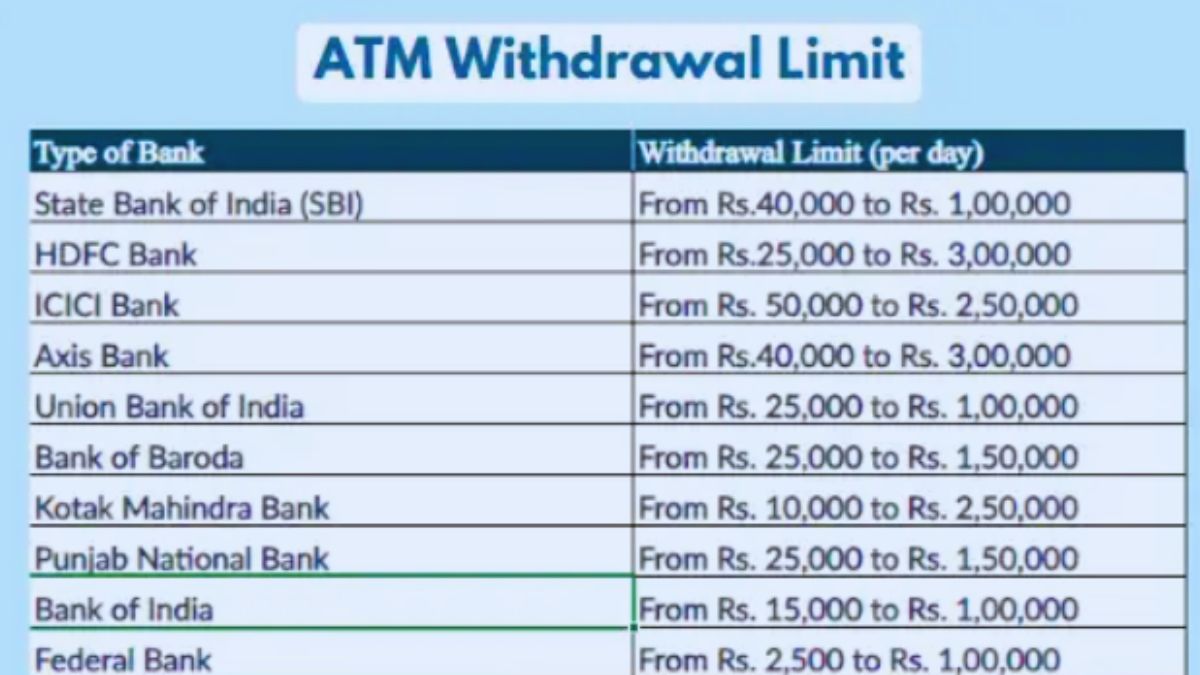
The ATM withdrawal limit is the maximum amount of money that can be withdrawn from a savings or current account on a daily basis. This limit varies between banks, typically ranges from a minimum of INR 20,000 to higher amounts from the ATM, depending on the type of account. Customers are requested to check the daily withdrawal limit with the respective bank before making any transaction to avoid a fee being imposed for crossing the permitted limit.
Though an increase in the ATM withdrawal limit is not encouraged or generally permitted, in certain exceptional cases this can be allowed, provided the necessary approval is received.
- Based on your account history, the type of accounts you hold, and the duration of the increase you request, it can be considered.
- A proper justification and supporting must be provided to the bank in order to claim a rise in your daily ATM withdrawal limit.
- Banks set cash withdrawal limits for security purposes. If the withdrawal limit is increased, you should be careful and keep an eye on your card usage, to avoid any unauthorized transactions.
Free ATM Usage Limit
The Reserve Bank of India has maintained the number of free ATM transactions per month. As per the latest rules which are applicable going forward include,
- 5 free transactions per month at own-bank ATMs (including financial and non-financial transactions)
- 3 free transactions per month at other-bank ATMs in metro cities
- 5 free transactions per month at other-bank ATMs in non-metro cities
These free limits include both cash withdrawal and non-financial transactions like balance enquiry or mini-statement requests.
Increase in ATM Charges
The Reserve Bank of India, RBI is the apex body at the central level, which monitors and supervises all the banking operations across the country. The guidelines and directives issued by RBI are adhered to by banks – both in public and private sector.
The RBI itself has allowed banks to increase ATM withdrawal charges to cover the rising costs. Maintaining ATMs, installing upgraded security systems and managing daily operations have become more expensive over time.
- To help banks meet the rising expenses and continue offering better services to customers, the incremental hike was approved recently.
- Higher ATM charges are expected to support banks in maintaining a wide ATM network and offer safer banking services to customers.
Understanding the new rules, free transaction limits, and updated fees is crucial for managing your banking costs effectively.
- In 2025, the Reserve Bank of India (RBI) has set a maximum ATM transaction fee of Rs 23 per transaction beyond the free monthly limit, effective from May 1, 2025.
- This applies to both financial and non-financial transactions at ATMs and CRMs, excluding cash deposits at CRMs.
- Customers generally get 3 free transactions at other bank ATMs in metro cities and 5 free transactions in non-metro areas. These free limits include both cash withdrawals and balance checks.
- There will be no changes in the free transaction limits.
- These charges will be applicable to savings account holders across all banks in India.
Customer Impact
The increase in ATM withdrawal charges from INR 21 to INR 23 per transaction may lead to slightly higher monthly costs for customers who frequently withdraw cash. A difference of two rupee for every single transaction will cost heavily to the customer and definitely drastically multiply the bank earnings to meet their rising expenditure.
Planning ATM visits carefully, using digital payment modes like UPI, and avoiding small frequent withdrawals can help customers manage and minimize extra charges. Plastic money (cards) can be used directly instead too – especially credit cards, to earn reward points. Although, one must be cautious and settle the bills on a regular basis to avoid interest being charged.
While the number of free transactions remains unchanged, customers should be mindful of their usage to avoid additional fees. Staying informed about the latest ATM charges can help you plan your withdrawals smartly and save unnecessary costs.
FAQs on ATM Charges 2025
1)What is the ATM charge per transaction from 2025?
Effective from May 1, 2025, RBI has set transaction fee of INR 23 per transaction beyond the free monthly limit for other bank ATMs.
2) How many free transactions for ATM are allowed?
For any ATM transaction, 5 free ones at own-bank 3 free transactions at other-bank ATMs in metro cities is permitted from 2025 onwards.
3) What is ATM full form?
ATM stands for Automated Teller Machine.